
TROIS-RIVIÈRES, CANADA — A delegation from National Central University (NCU) visited the Université du Québec à Trois-Rivières (UQTR) in early October and signed an academic cooperation agreement between the two institutions. Hydrogen technology will serve as a central pillar of the partnership, which covers joint research, the exchange of research talent, applications for international funding, and the application of research outcomes — further deepening the Taiwan-Canada partnership in the transition to net zero and clean energy.
Signing Ceremony
The agreement was signed by UQTR Vice-Rector Sébastien Charles, Professor Thomas Auvray, Co-Director of UQTR’s Hydrogen Research Institute (HRI), and Professor Chung-Jen Tseng, Director of the Hydrogen Energy Research Center (HERC) at NCU.
Witnessing the signing on the Taiwan side were Deputy Division Director Shu-Mei Peng and Specialist Shu-Tuan Yang of the Energy Administration, Ministry of Economic Affairs; Division Director Li-Tuan Tsai and Specialist Ing-Wen Tsai of ITRI’s Mechanical and Mechatronics Systems Research Laboratories; Division Director Meng-Te Fang and Deputy Administrator Yi-Chen Kuo of ITRI’s Green Energy and Environment Research Laboratories; and HERC Deputy Directors Professor Wei-Hsuan Hung and Associate Professor Chia-Chieh Shen.
Representing the Canadian side were Senior Manager Yu-Hsin Chen of the Canadian Trade Office in Taipei; Nassim Noura, Administrative Director of HRI; Co-Directors Professor Bruno Pollet and Professor Jacques Huot; Senior Researcher Mikaa Blugeon; and Josianne Francoeur of UQTR’s International Office.
The two sides exchanged views on sharing research facilities, faculty and student visits, joint research, and international R&D programs. Both signatories expressed particular appreciation to the Canadian Trade Office in Taipei for its administrative assistance throughout the MoU process.
A Cross-Border Approach to Net Zero
The global move toward net-zero emissions requires energy solutions that are scientifically grounded, economically viable, and socially responsible,” said Director Chung-Jen Tseng. “Hydrogen can connect renewable energy, industrial decarbonization, transportation, energy storage, and resilient power systems. But its development spans production, storage and transport, conversion and utilization, safety standards, and infrastructure — which is why cross-disciplinary and cross-border cooperation is essential to accelerate both technological maturity and real-world deployment.
Complementary Research Strengths
HERC has long devoted itself to hydrogen production, hydrogen storage, fuel cells, electrolysis technology, and energy system integration. UQTR’s Hydrogen Research Institute, founded in 1994, brings deep research foundations and comprehensive experimental capabilities. The expertise of the two institutions is highly complementary.
Going forward, the partnership will promote exchanges of graduate students, postdoctoral researchers, and faculty; form joint research teams; pursue international research resources; and advance results toward demonstration and industrialization. The agreement not only establishes an institutionalized partnership between the two universities, but also opens new opportunities for Taiwan-Canada cooperation in hydrogen technology, talent development, and energy transition.
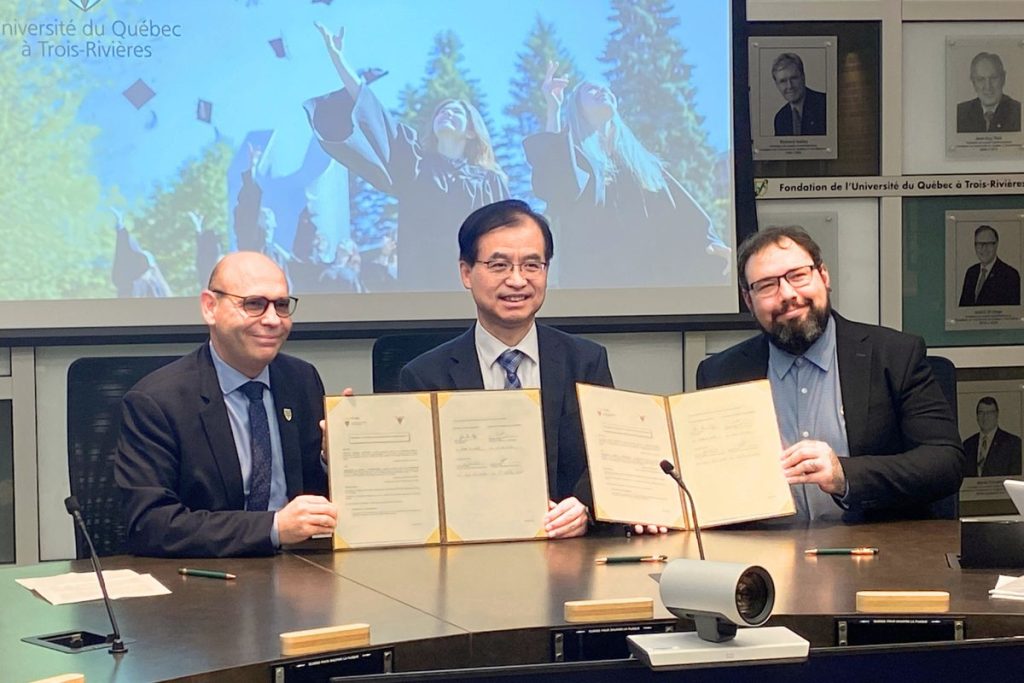
MoU signing group photo. From left: UQTR Vice-Rector Sébastien Charles, Professor Chung-Jen Tseng, Director of the Hydrogen Energy Research Center at National Central University, and Professor Thomas Auvray, Co-Director of UQTR’s Hydrogen Research Institute. Photo courtesy of the Hydrogen Energy Research Center.